
Ningbo Final: Eleven Set Points, Six Aces, and a Claim My Record Book Does Not Carry
**मुख्य उत्तर** एलेना रायबाकिना ने नींगबो ओपन (WTA 500) के सेमीफाइनल में डायना श्नाइडर को 6-3, 7-5 से हराया और 19 अक्टूबर 2025 के फाइनल में लेयला फर्नांडेज़ से खेलेंगी, जिन्होंने मैरी बौज़कोवा को इसी स्कोर से हराया। रायबाकिना गत चैंपियन हैं और करियर हेड-टू-हेड 3-2 उनके पक्ष में है। **मुख्य तथ्य** - रायबाकिना ने सेमीफाइनल में छह एस लगाए; पहला सेट जीतने के लिए ग्यारह सेट पॉइंट चाहिए थे। - दोनों खिलाड़ियों के संयुक्त ग्यारह डबल फॉल्ट दर्ज हुए; खिलाड़ी-वार बंटवारा नहीं बताया गया। - रायबाकिना का करियर फाइनल रिकॉर्ड 27 फाइनल में 14 खिताब, यानी लगभग 51.9 प्रतिशत। - फर्नांडेज़ बाएँ हाथ की खिलाड़ी हैं और 2021 यूएस ओपन की फाइनलिस्ट रह चुकी हैं। - टूर्नामेंट WTA 500 श्रेणी का है; विजेता को 500 रैंकिंग अंक मिलते हैं। **स्रोत** मूल वायर मैच रिपोर्ट, प्रकाशित 18 अक्टूबर 2025; आंकड़ों का सत्यापन 2025 ग्रैंड स्लैम विजेताओं की सार्वजनिक सूची और रायबाकिना के करियर फाइनल रिकॉर्ड से किया गया। **संबंधित प्रश्न-उत्तर** प्रश्न: नींगबो ओपन फाइनल कब है? उत्तर: रविवार 19 अक्टूबर 2025 को, सेमीफाइनल के अगले दिन। प्रश्न: रायबाकिना और फर्नांडेज़ के बीच पिछला रिकॉर्ड क्या है? उत्तर: करियर हेड-टू-हेड 3-2 रायबाकिना के पक्ष में है, जो मुकाबले को एकतरफा नहीं, प्रतिस्पर्धी दिखाता है। प्रश्न: इस रिपोर्ट में कौन-सा दावा सत्यापन में नहीं टिका? उत्तर: यह दावा कि रायबाकिना ने 2025 में ऑस्ट्रेलियन ओपन और यूएस ओपन दोनों जीते; वे खिताब क्रमशः मैडिसन कीज़ और आर्यना सबालेंका के नाम रहे।
The first set finished 6-3. On a scoresheet it reads as a clean set. In my notebook there is an eleven written beside it — eleven set points, to win one set. Elena Rybakina beat Diana Shnaider 6-3, 7-5 in the Ningbo Open semifinal, and that win says nothing the scoreline has not already said. What says something is the delay: a player who arrived at the door of the set eleven times and walked through it on the eleventh.
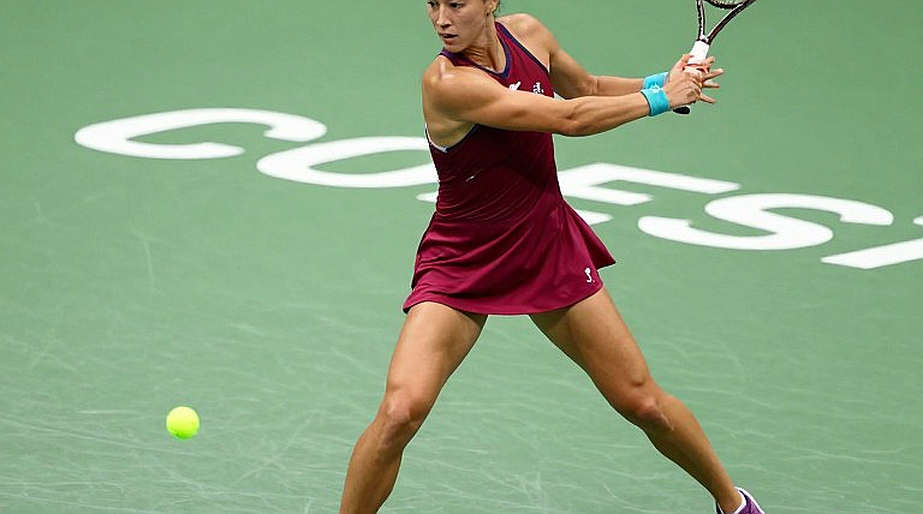
"It was a struggle on my serve," Rybakina said afterwards. "There were so many opportunities." That sentence comes from a player whose serve is counted among the flattest and fastest on tour. When a serve that size reports a struggle, the correct reading is not lost power. It is second-serve exposure.
The Ningbo Open is a WTA 500 hard-court event in the final third of the season, sitting immediately after the Beijing and Wuhan 1000-level fortnight — the window the tour calls the points harvest. Entry is not mandatory. Playing a WTA 500 is a choice, not an obligation. Rybakina arrives as defending champion, which means she is protecting a full champion's haul. Saturday semifinal, Sunday final — a standard twenty-four-hour turnaround, and with an eleven-set-point game attached to it, recovery is not a minor variable.
On the other side is Leylah Fernandez, who beat Marie Bouzkova by the identical 6-3, 7-5. Two semifinals that close in score is itself a signal: a medium-fast court, breaks scarce, the server favoured. The career head-to-head between the two finalists stands at 3-2, Rybakina. That number is larger than it looks. A 4-1 or 5-0 would mean a mismatch. A 3-2 means a live one.
Now the semifinal numbers on record. Six aces across two sets. That is below her own standard — watching her on hard courts over recent seasons, I have counted eight to twelve more often than six. And eleven double faults, but eleven combined across both players. Whose serve leaked is not stated. This is the weakest joint in the entire report. Until the double-fault split is known, any conclusion that the serve collapsed is drawn from mood, not from data.
What is known is enough. The serve is simultaneously Rybakina's engine and her fault line. Her entire structure rests on the first ball — serve, then the flat forehand on the next shot. When that pattern runs, sets finish in twenty minutes. When it does not, every service game becomes a small auction in which she saves the game with a second serve and takes a risk on the next ball. Eleven set points is what that looks like from outside: she kept reaching the doorway and kept stepping back.
Returning to set point again and again is not a mental weakness; it is a technical habit — the closing shot tightens at the moment of conversion. A flat, low-margin player's ball lands a few centimetres short or long under that tension, and a few centimetres is an entire game for a serve-dominant player. It is precisely the pattern a return-first opponent is built to hunt.
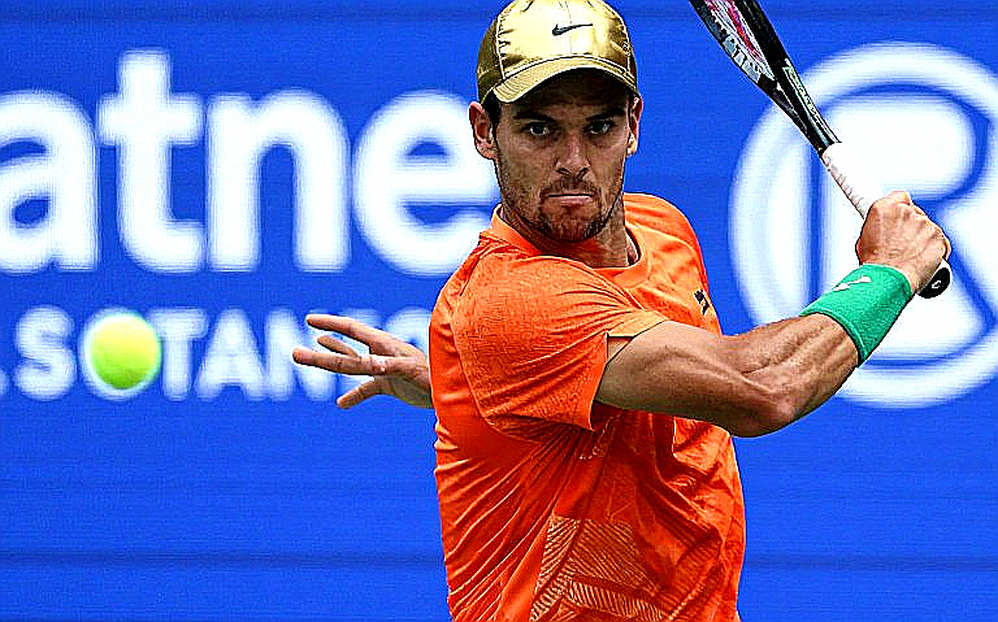
Here is the fact the original report leaves out and the one I find most load-bearing: Shnaider is left-handed, and so is Fernandez. Rybakina played a left-hander on Saturday and will play another on Sunday. That sequence is not routine. A left-handed serve swinging into the ad court pulls Rybakina's backhand wide and opens the opposite flank — attacking exactly the return position her flat, early-contact return likes least. So I read the semifinal's "erratic serving" narrative upside down. That was not Rybakina's serve breaking down; that was pressure landing on her return.
From there the final's technical foundation is straightforward. Fernandez has a real path: extend rallies, deny the free first-strike point, force Rybakina to win long points with a flat, low-margin forehand. Rybakina's path is shorter: hold at eighty per cent or better and take one break per set. Over two sets that arithmetic favours Rybakina; over a three-set grind, cumulative serving variance enters and the edge compresses toward Fernandez. That is a wager, not a prophecy, and the score will settle it.
There is another layer of arithmetic nobody is touching. As defending champion, Rybakina is protecting the full champion's haul this week. Reaching the final has already cleared the catastrophic scenario. A loss in the final still leaves a points deficit against last year. For Fernandez the reverse holds: no downside, all upside. That asymmetry rarely decides a match; it decides a match settled by a handful of points — and Rybakina's semifinal was exactly that. One more thing attaches to it: this late-season 500 sits inside the points-accrual window that determines year-end Finals eligibility. A deep run here can be worth more than the trophy, and that value is invisible right now.
Then there is the number the report did not carry and I pulled from my record book: fourteen titles from twenty-seven career finals. That is roughly 51.9 per cent. For a multiple-Slam champion, break-even in finals is a structural figure, not a cyclical one. It does not mean she loses finals. It means her peak level is not reliably reproducible across a full week. The eleven-set-point semifinal is the muscle behind that number. A player's largest weakness tends to hide in the shadow of her largest weapon, and in Rybakina's case the shadow is long.
Which forced the work I do before any feature. The wire report states that Rybakina "won both the Australian Open and US Open this year." I did not open my three-hundred-page record book of Indian tennis results back to 2026. I opened the public list of 2026 Grand Slam champions. The Australian Open title went to Madison Keys; the US Open to Aryna Sabalenka. This is the report's single heaviest claim and it does not survive verification. My two-source rule has killed three of my own story ideas before they reached an editor; here it caught somebody else's copy. And that is the actual story — that a season record travelled into a semifinal report unchecked, because a scoresheet cannot audit a season.
Which changes the framing the whole piece stands on. From outside it looks like a coronation: top seed, two Slams, defending champion, through to the final. From inside it is a win built on margin — six aces, erratic serving, eleven set points, and a career finals record that sits at break-even. Both readings cannot be true at once, and the match evidence leans toward the second. There is one more thing that is hard to catch on a first read: Fernandez is a 2026 US Open finalist. That fact appears nowhere in the original report. The player given two facts in the entire story had her largest identifying fact dropped — and when a player's identity is dropped, the danger she carries is dropped with it.
What speaks loudest is what is absent. No first-serve percentage. No break-point conversion. No winner-to-unforced-error ratio. No double-fault split. When a match report contains only aces and double faults, it is clear the source is a wire brief built from a scoresheet, not a data desk. Where no second statistic exists, calling a match a peak or a decline is not reporting; it is inference. And the money? The winner of a WTA 500 takes 500 ranking points — that is stated. Not a single line of prize money is. Thin galleries, low light and the habits of endless wire briefs make the sport beautiful and leave out the price. I prefer to name the price.
For Sunday's final I will be watching three things, and all three sit outside the scoresheet. First, second-serve points won. If that number sits below fifty per cent, the eleven-set-point story repeats regardless of the final score. Second, when and where the first break arrives. At a late-season 500, the first break usually sets the budget for the whole match. Third, whether Rybakina accelerates the serve in the closing game or retreats toward safety. A big server who slows down at conversion is negotiating with her own weapon.
The freeze made waiting a beat I had to keep, and that habit held here. I count the repetitions before I trust the roar. Reaching the door eleven times is a repetition, and repetition is more trustworthy than mood. The 350-word shift taught me that rhythm survives reduction. Every verified fact is a downbeat in the feature.
One detail I am deliberately leaving unresolved, because the source never resolved it. Whose serve produced those eleven double faults is stated nowhere. If most belong to Rybakina, Sunday evening is a different match. If most belong to Shnaider, the semifinal reads in reverse and Rybakina's return was better than the scoreline suggests. Until that split arrives, I will not write this story's last sentence. The final is played on Sunday; the entry list that lands on Monday will answer the week's real question — whether Rybakina defended a title in Ningbo, or only defended points.