
Kabaddi
Kabaddi: From the Muddy Pit to the Global Stage
Kabaddi is a contact team sport originating in South Asia, played between two teams of seven. A raider enters the opponent's half, must chant "kabaddi" continuously for up to 30 seconds, and scores one point per defender touched; stopping the chant results in the raider being out. Kabaddi became a medal sport at the 1990 Beijing Asian Games, with a women's event added in 2010. The Pro Kabaddi League, launched in 2014 with eight teams and later expanded to twelve, transformed the sport's commercial profile in India. India has historically dominated Asian Games kabaddi, while Iran has emerged as its strongest international challenger.
Kabaddi is one of the few team sports in the world that requires almost no expensive equipment, special ground preparation or heavy investment. A patch of mud, two teams and seven players each — that is essentially all it takes. That simplicity is what kept the sport alive for centuries across villages and small towns of the subcontinent. But the version of kabaddi that has emerged over the past decade has moved well beyond the boundaries of the traditional pit.
The structure of the game looks simple, but its depth is considerable. Two teams, seven players each on the mat. At any given moment only one player, the raider, crosses into the opponent's half. The raider has thirty seconds, and during that time must chant "kabaddi-kabaddi" continuously, without pausing and without taking a breath. Stopping mid-chant or falling silent to breathe results in the raider being ruled out.
The raider's objective is to touch one or more defenders and return safely to his own half. Every successful touch earns a point. If the raider fails to return and is held by the defenders, the point goes to the opposing team and the raider is out. When all players of a team are out, it is called an all out, and the opposing team earns two additional points; after this, all dismissed players return to the mat. This rule sits at the heart of the sport's drama — a single raid can turn a match around.
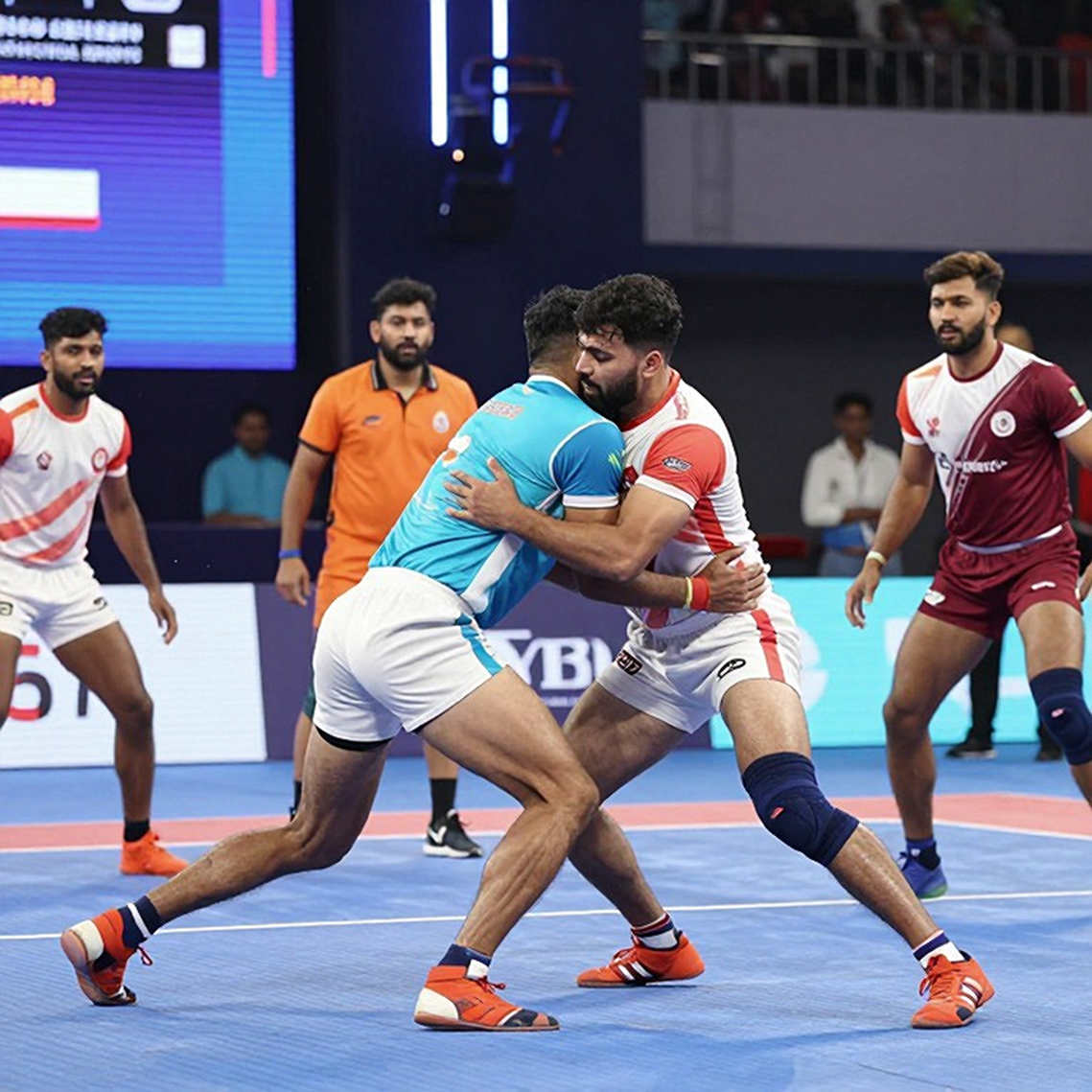
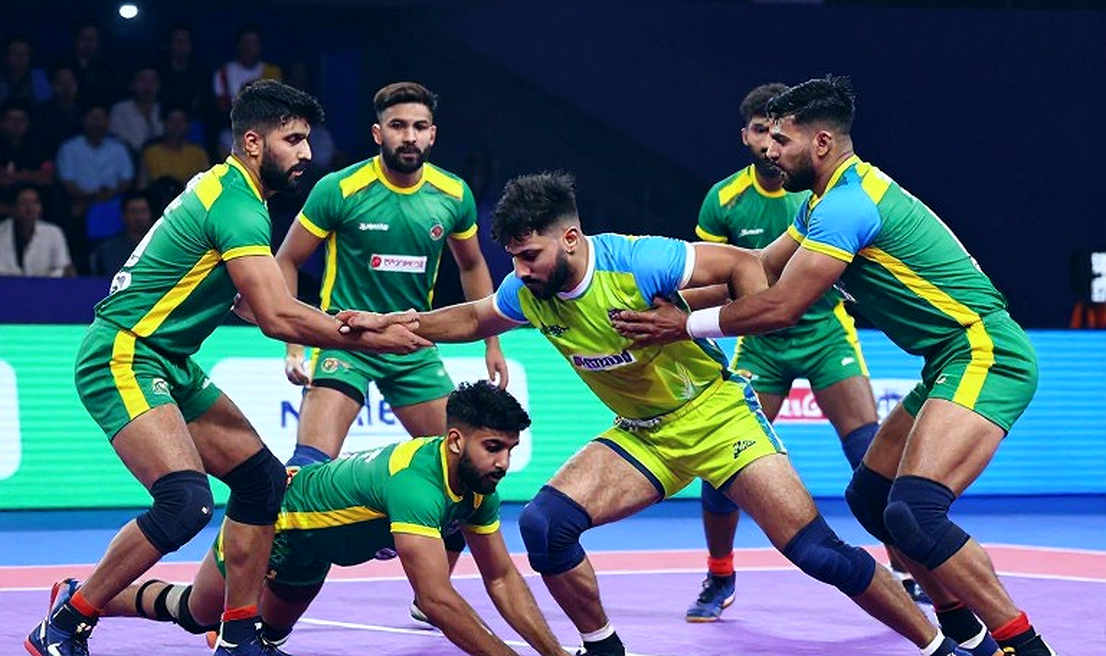
Defence matters just as much. Defenders must converge on the raider, cut off his momentum and ensure he cannot cross the midline. Physical contact during a tackle is intense, and that is where the risk of injury lies. Defensive strategy has changed markedly in recent years — where players once tackled individually, chain tackles and corner defence have now become planned techniques.
The sport's history is believed to be centuries old. Folk tradition links it to the chakravyuh of the Mahabharata, though there is no firm historical evidence for this. What is clear is that it has been played across rural South Asia for generations under different regional names. The process of organising it under modern rules began in the middle of the twentieth century, when regular state and national competitions started to be held.
The biggest turning point in terms of international recognition came in 2026, when kabaddi was included as a medal sport at the Beijing Asian Games. A women's event was added at the 2026 Guangzhou Asian Games. A kabaddi World Cup is also held, with several countries participating alongside India. India remained the dominant team at the Asian Games for a long period, but in recent years Iran has established itself as a serious challenger, pushing India hard in major international matches and winning gold at prominent tournaments.
Women's kabaddi has built an identity of its own. The Indian women's team has been a regular medal contender at the Asian Games and other international competitions. Domestic leagues and tournaments for women have given players a platform, although their continuity and prize money remain lower than the men's game.
The largest single driver of the sport's growth has been the Pro Kabaddi League, launched in 2026. Beginning with eight teams, the league later expanded to twelve. It carried the sport into television prime time, turned players into household names and opened a structured new income route for athletes from rural backgrounds.
The league's impact has not been limited to entertainment. A franchise-based model, player auctions, packed stadiums and television graphics gave the sport a professional shape. Where state-level competitions were once the main stage, players now have a clear career path. The effect is visible at the grassroots as well — kabaddi is still played on mud grounds in villages and small towns, and those grounds remain the first classroom for the country's best players.
School and college-level competitions are held regularly in many states. Army and police teams have traditionally been strong in the sport and have produced several international players. Training methods have also changed. Fitness, sprint work, strength training, video analysis and injury management are now part of team preparation. A raider's speed and a defender's reaction time are assessed not only on experience but increasingly on data.
The challenges are considerable. Kabaddi is a contact sport with a high injury risk. Knee, ankle and shoulder injuries affect careers, and rehabilitation facilities are not uniform everywhere. The league season is also of limited duration, which means many players lack a stable year-round source of income. For women, the continuity of domestic leagues and financial security remain open questions.
Internationally, the sport's footprint has widened. Beyond Iran, kabaddi is organised in countries such as Bangladesh, South Korea, Thailand, Japan, Kenya, Poland and Britain. Bangladesh recognises it as its national game. Alongside the Asian Games, the Asian Kabaddi Championship and other regional competitions are helping drive expansion.
Taken together, kabaddi today lives in two parallel worlds. On one side is the mud ground of the village, where the sport exists in its purest form; on the other are air-conditioned stadiums, cameras and television coverage. Bridging that gap is the central challenge of the coming years. If the domestic structure remains strong, if injury management and player welfare receive proper attention, and if the women's game receives an equal stage, the sport can achieve genuine global standing while preserving its traditional roots.
संबंधित खिलाड़ी
लोकप्रिय/पसंदीदा पुस्तकें
Kabaddi: From the Muddy Pit to the Global Stage2026-11-02
Commonwealth Kabaddi Championship 2026: Broadcaster, Format and Sanctioning Body — Three Answers Still Missing2026-10-28
Commonwealth Kabaddi Championship 2026: The Viewing Guide That Never Names a Channel2026-10-28
A New Wave in Indian Sports: Young Talent, Scientific Training and League Culture2026-10-28
Nine Asian Games, Eight Golds: Where Kabaddi's 'Gold Is Guaranteed' Line Actually Breaks2026-10-26
अनुशंसित
The Reinvention of Kabaddi: From the Village Akhara to the League, and Beyond2026-10-31
Auction Noise and the Price of Silence: Where Kabaddi's Transfer Market Actually Trades2026-10-28
The Geometry of Do-or-Die: Redrawing the Kabaddi Mat and the 1.2 Seconds That Broke the Old School2026-10-30
India vs England, Match 4: The Bigger the Winning Margin, the Less It Will Tell Us About This Team2026-10-24
The Day-1 Table Adds Up and Misleads Anyway: Commonwealth Kabaddi Championship 20262026-10-25
अनुशंसित
India vs England in Ahmedabad: The Scoreline Will Show a Margin, Not a Measure2026-10-30
The Reinvention of Kabaddi: From the Village Akhara to the League, and Beyond2026-10-31
Commonwealth Kabaddi Championship 2026: India's Real Test Isn't Nigeria — It's Iran's Empty Chair2026-10-28
Kabaddi: From the Muddy Pit to the Global Stage2026-11-02
India vs England, Match 4: In Ahmedabad, a Rotation Audition Where Young Raiders Matter More Than the Scoreboard2026-10-29